
PROFI CONSULTING
from 9am to 5pm


No products
Free shipping! Shipping
0,00 €Total
Product successfully added to your shopping cart
( pcs)
Buy for and have delivery free.
No products
Subcategories


Exhaust components of all shapes and dimensions. Build your own exhaust according to your expectations using stainless steel parts from our offer:
• dimensions from 34 to 89 mm
• exhaust pipes straight, 45°, 90°
• straight reduction, Y and X
• stainless steel: T409, T304
The most common material used in performance exhaust systems is T409, which does not have good resistance due to the lack of chromium to whithstand cold and damp weather and after just one winter there are signs of corrosion on the surface because of grit salt.
T304 is stainless steel of the highest quality in automotive industry, which is sused to produce tailpipe exhaust, exhaust fittings and other exhaust components, where high strength and durability are required. T304 material is non-corrosive because it contains more than 20% chromium and 10% nickel in its composition, but due to the lack of iron content it is changing color to gold at high temperatures. In fact, the ferrous metal content is so low that magnets will not stick to it, making the distinction between T409 and T304 very easy.


This is the first part of the exhaust pipe after the turbo that contains the DPF/ OPF/ GPF or catalytic converter. Depending on the orientation of the engine, this part is located in the engine compartment or under the car connected by a V-band or other connector directly to the turbocharger(s).
The advantage of OEM location is the capture of still hot exhaust fumes and their processing before the next passage through the complete exhaust system. Since the Euro-norms are currently very strict, there are more and more such filter parts on the exhaust system and they become more and more dense and restrictive for the engine itself. Not to mention, on high-mileage vehicles, the filter unit can become clogged, causing reduced performance and other permanent damage.


This product consists of stainless steel or titanium pipe for a specific type of car, which does not contain any filter parts or anything that would limit the flow of gases. The shape is aimed at the smoothest possible flow of exhaust gases, while the diameter is larger than standard to achieve an increase in performance. The downpipe contains all the necessary outputs to the sensors in order to maintain the normal functionality of the engine. Sometimes the downpipe contains a flexible exhaust coupling or is wrapped in Inconel thermal insulation, which reduces the temperature on the surface, which helps to keep the temperature in the engine compartment low, and at the same time accelerates the gases flowing through the pipe.

The main advantage and purpose of installing a tuning downpipe is to remove the DPF in diesel vehicles and the OPF/GPF/catalyst in gasoline vehicles. The result of removing the restrictive filter unit from the pipeline is an increase in performance (ECU modification is recommended for maximum efficiency). Lowering the engine compartment temperature is another plus, as the DPF/OPF or catalytic converter must reach a certain temperature for proper functionality. Integral parts of stock downpipes are also probes that detect flow gases, their pressures or temperature, on the basis of which the permeability, overall condition and even the functioning of the DPF are evaluated. By replacing an OEM downpipe equipped with a DPF/OPF or a catalytic converter, it is therefore possible to remove even such a complex sensor wiring (ECU modification is required). Tuning downpipes have an incomparably lower weight than OEM units, which improves vehicle handling and reduces the overall load on all components, especially engine mounts.
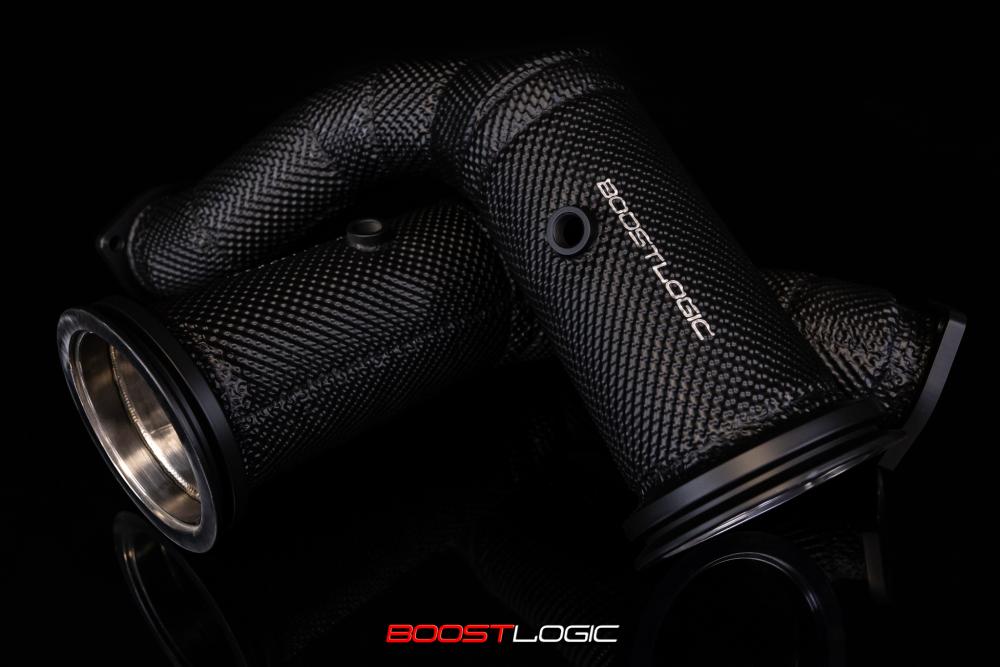
By installing a downpipe, there is no filtration of exhaust gases, which therefore enter the atmosphere without any processing and thus pollute the environment. After replacement, modification of the engine control unit is recommended, which can be expensive. For newer models, this change may remain recorded in the ECU even after the stock parts are reinstalled, which may cause problems during service inspections.
With a downpipe nowadays, it is not possible to successfully pass the emission and technical inspection due to the strict Euro-norms. However, today it is also possible to find downpipes equipped with catalysts with higher flow or a silencer, thanks to which there is still proper filtration of exhaust gases and a simultaneous increase in engine performance. With this exhaust part, a successful emission and technical inspection is often possible.

In our offer you will find many downpipes for different car models. In case of any questions, do not hesitate to contact us at info@races-shop.com.


